
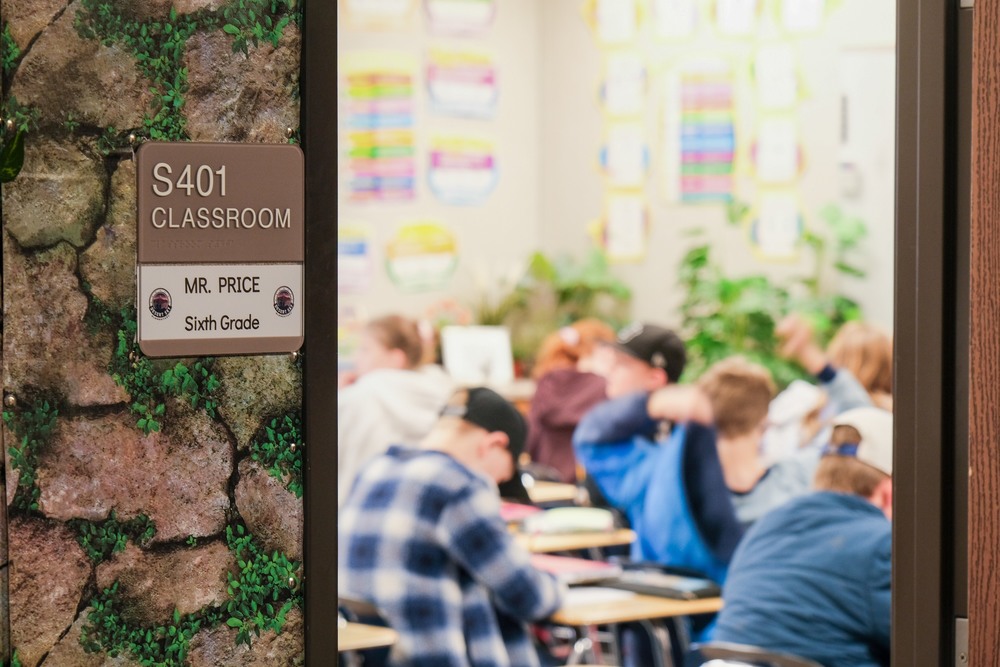
Faced with a shortage of instructional space, Desert Sky Elementary has turned a logistical hurdle into a bridge to middle school success.
The Desert Sky 6th Grade Center, located less than a mile away at Frontier Middle School, operates as a self-contained satellite campus. While the decision was made last April to address immediate overcrowding, the results have surpassed the expectations of administrators, teachers, and students alike.
It was a strategic use of existing district facilities to manage the challenge of high-growth.
A Creative Solution to Limited Space
“We were out of instructional space,” said Aaron Stevenson, principal at Desert Sky Elementary. “We had more teachers than classrooms available.”
Instead of going to the main Desert Sky campus, 6th-grade students go instead to Frontier Middle, a few blocks away. A satellite classroom pod provides five classrooms, an office, a teacher work room, and restrooms.
Stevenson noted that this is a solution to a temporary problem, as many students currently living in Desert Sky’s boundaries will attend a new elementary school, currently under construction, next school year.
“We naturally feel a bit isolated,” said Seth Price, a 6th-grade teacher at Desert Sky. “We’ve had to get creative in coordinating special education, ELL, and speech and occupational therapy. We’ve had to build this all from scratch, knowing it was temporary.”
The change has been noticeable, and students are getting used to it.
“I feel like it's less people and less noise,” said Tessa Butler, one of the 6th-graders. “It’s nice because there's less distractions and it’s easier to learn,” she said.
“Being separated from the elementary building has allowed us to give them a level of autonomy that wouldn’t be possible elsewhere,” said Price.
Preparing Students for Change
For the teachers who built the program from scratch, the experiment has proven that 6th-graders are ready for the challenge. Holding classes at Frontier has given them the opportunity to get a sneak peak at middle school life.
“I’m really getting a feel of middle school by being here,” said Cai Lindsay, a 6th-grader in Price’s class. “I feel like I’m ready.”
While the 6th-graders remain separate from the main middle school student body to avoid mingling in the halls, they utilize the middle school’s specialized facilities for PE, STEM, music, and lunch. All this and they are still Desert Sky Explorers. It’s a nice middle ground for rising middle schoolers.
“We’ve loved having our student organizations continue to be a part of our school,” said Stevenson. “Sixth-graders continue to be part of our choir, bucket band, student council, school play, kindness club, and so much more,” he said
“My students have felt more like teens than in previous years,” Price said. “They are stepping up to the challenge and showing they’re ready for some independence. I typically have a handful of kids who are terrified about the move to 7th grade. This year, I don’t have any,” he added.
Growing Stronger through Challenges
The transition hasn’t been without its challenges for both staff and families. Students must be bused to Desert Sky first before heading to the 6th Grade Center. This double-busing results in a late start and early end to the day.
“There has been a lot of trial and error as we figured out how to build this program up,” said Price. “An unexpected benefit is that our students have seen us, the adults, struggle to figure out solutions to problems we haven’t had to deal with before. They’ve seen us navigate unknown waters, and make adjustments as necessary. I think they’ve shown a lot of resiliency, and adapted quite nicely.”
Despite the logistical messiness, school leaders see the model as a success that could be replicated in other high-growth areas.
“The 6th Grade Center has far exceeded my expectations,” said Stevenson. “We’ve had lots of opportunities to improve on what was a really great opportunity. It certainly solved an immediate problem, but in the end it has provided far more opportunities than originally expected.